 ×
×


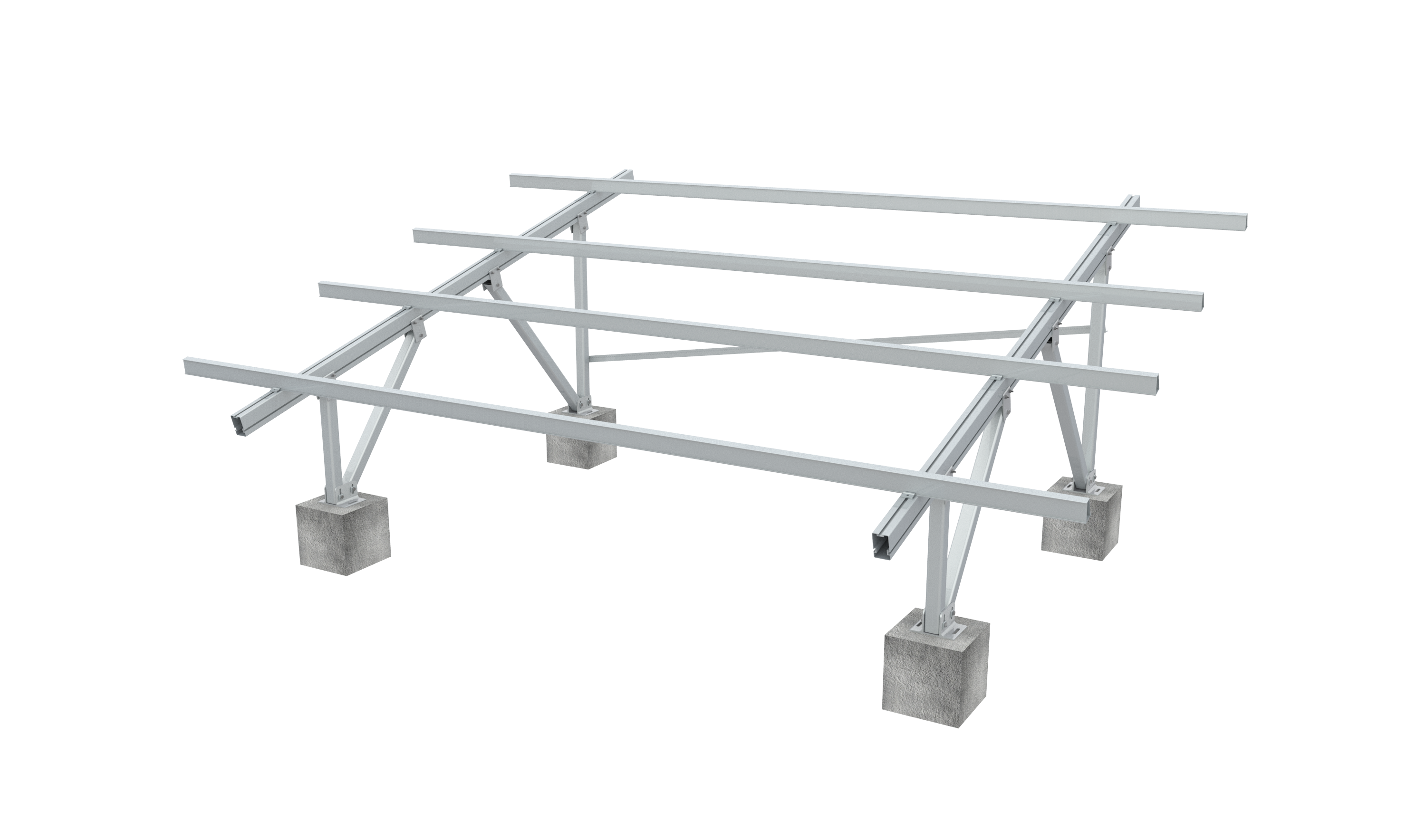
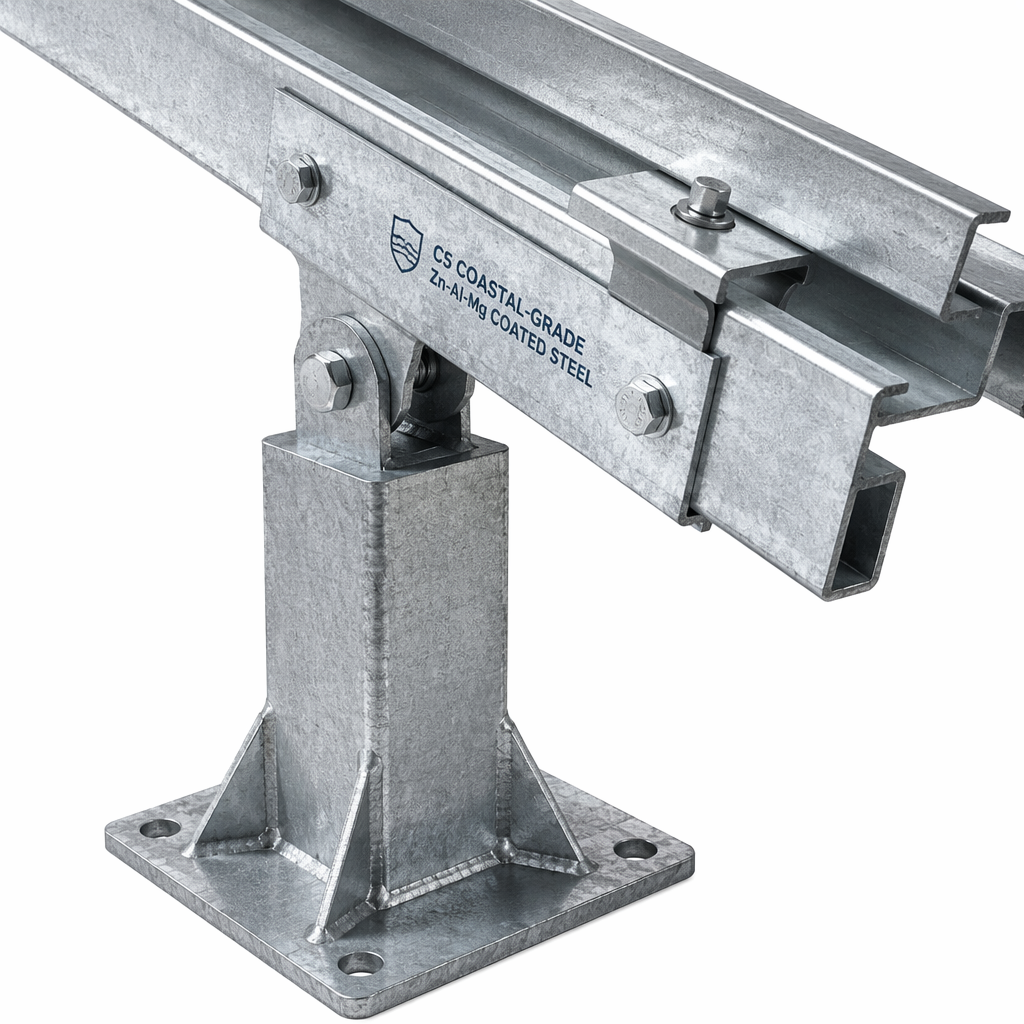
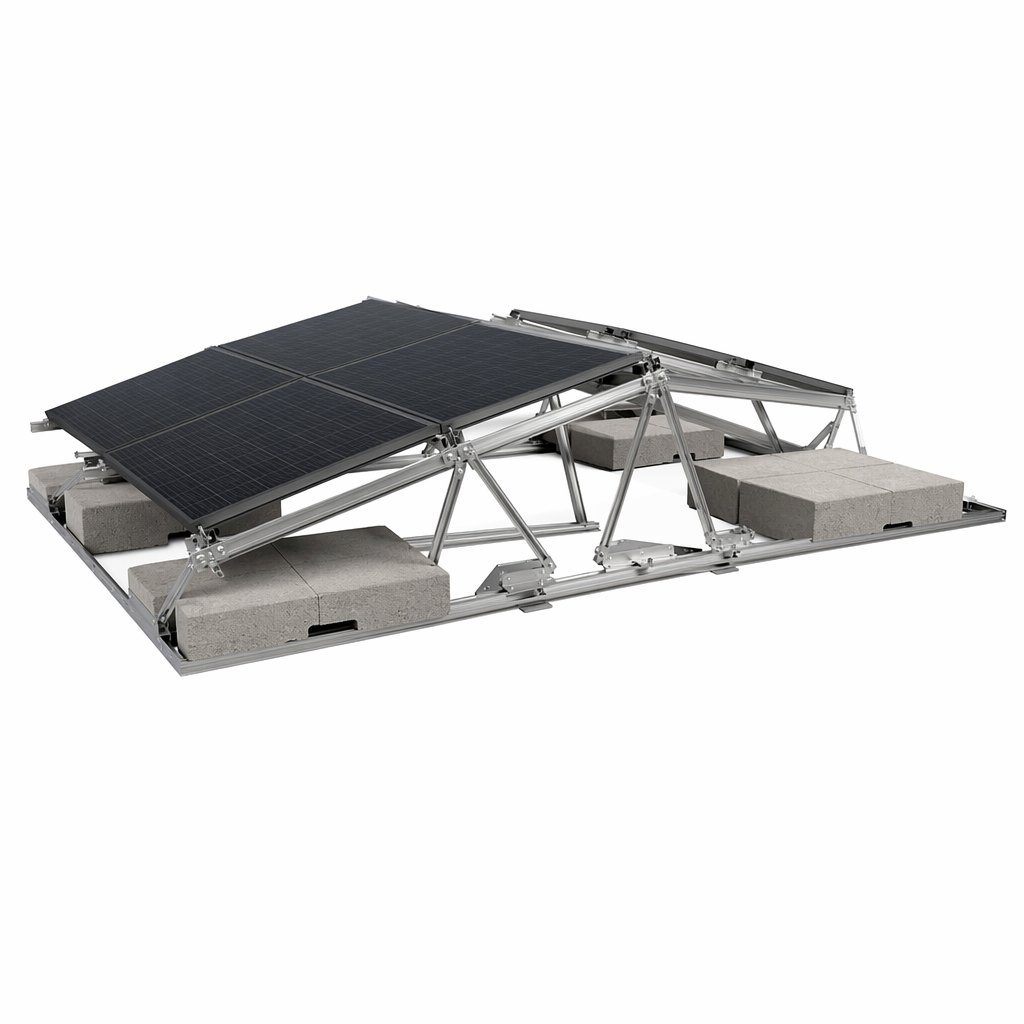
C5 Coastal-Grade Fixed-Tilt Ground Mount | Maximum Corrosion Protection for Offshore, Island, and Salt-Spray Solar Projects
Coastal and offshore-adjacent solar sites deliver the most aggressive corrosion environment in the PV industry. Salt spray (chloride deposition rates exceeding 300 mg/m²/day within 500m of breaking surf), constant high humidity (80% RH), and frequent condensation cycles create conditions where standard HDG structures can show red rust within 5–7 years — a quarter of their design life.
The C5 Coastal-Grade Fixed-Tilt Ground Mount System is purpose-engineered to operate for 25 years in ISO 9223 C5-M (marine) and C5-I (industrial-marine) environments without structural degradation. The system pairs Q355B structural steel with a Zn-Al-Mg alloy coating — not as an option, but as standard specification — providing a self-healing, cut-edge-protective barrier that standard HDG cannot match.
Key engineering decisions that make this a C5 system, not a "C4 system used near the coast":
Zn-Al-Mg coating chemistry, not just thicker zinc: The aluminum component forms a stable passive layer, while magnesium creates a pH-buffering effect that slows zinc dissolution in chloride-rich condensate. Independent testing (ASTM B117) demonstrates 3,000+ hours to first red rust vs 1,000–1,500 hours for 85μm HDG
SS304/SS316 stainless steel fasteners as standard: Carbon steel fasteners — even HDG — are the first failure point in coastal installations because the thin zinc coating on thread crests wears during installation, exposing bare steel. All fasteners in this system are austenitic stainless steel, eliminating this vector
Cre vice-free connection details: All post-to-beam and rail-to-rail connections use gasketed, mechanically isolated interfaces that prevent the formation of crevices where chloride-rich water can stagnate and drive localized corrosion
Full-coverage post embedment protection: For ground screw and driven pile foundations, the below-grade portion receives an additional epoxy-based coating to protect the steel-soil interface in saline groundwater conditions
The jump from C4 to C5 is not incremental — it is a step change in corrosion mechanism:
Parameter |
C4 Inland-Coastal |
C5 Marine (This System) |
Chloride deposition |
60–300 mg/m²/day |
300 mg/m²/day |
Time to first red rust (HDG 85μm) |
15–20 years |
5–8 years |
Time to first red rust (Zn-Al-Mg) |
30+ years |
20–25 years |
Dominant failure mode |
Uniform zinc dissolution |
Pitting and crevice corrosion |
Critical design measure |
Coating thickness |
Coating chemistry + geometry |
Parameter |
Specification |
Structure Type |
Fixed-Tilt Ground Mount (C5 Coastal Grade) |
Tilt Angle |
10° fixed |
Module Layout |
2×10 / 2×12 |
Primary Material |
Q355B structural steel |
Surface Treatment |
Zn-Al-Mg alloy coating (standard, C5) |
Fasteners |
SS304 / SS316 stainless steel (standard) |
Gasketing |
EPDM isolation at all dissimilar-metal interfaces |
Design Wind Load |
Up to 50 m/s (typhoon/hurricane zones) |
Design Snow Load |
Up to 5,400 Pa |
Foundation |
Ground screw with epoxy-coated below-grade zone / Concrete |
System Voltage |
1500V DC |
Design Life |
25+ years (C5 environment) |
Warranty |
25 years structural |
Island nation solar projects (Caribbean, Pacific Islands, Maldives, Seychelles)
Coastal utility projects within 500m of shoreline
Offshore platform auxiliary power
Desalination plant solar integration
Tropical coastal industrial zones
Typhoon/hurricane-prone coastal regions requiring combined C5 + high wind design
Step |
Activity |
Coastal-Specific |
1 |
Site survey |
Chloride deposition measurement (wet candle method, ISO 9225) |
2 |
Foundation |
Epoxy-coated ground screws or reinforced concrete with sulfate-resistant cement |
3 |
Post installation |
EPDM gasket at post-base interface |
4 |
Beam assembly |
SS304/SS316 fasteners, isolation gaskets at all contact points |
5 |
Rail installation |
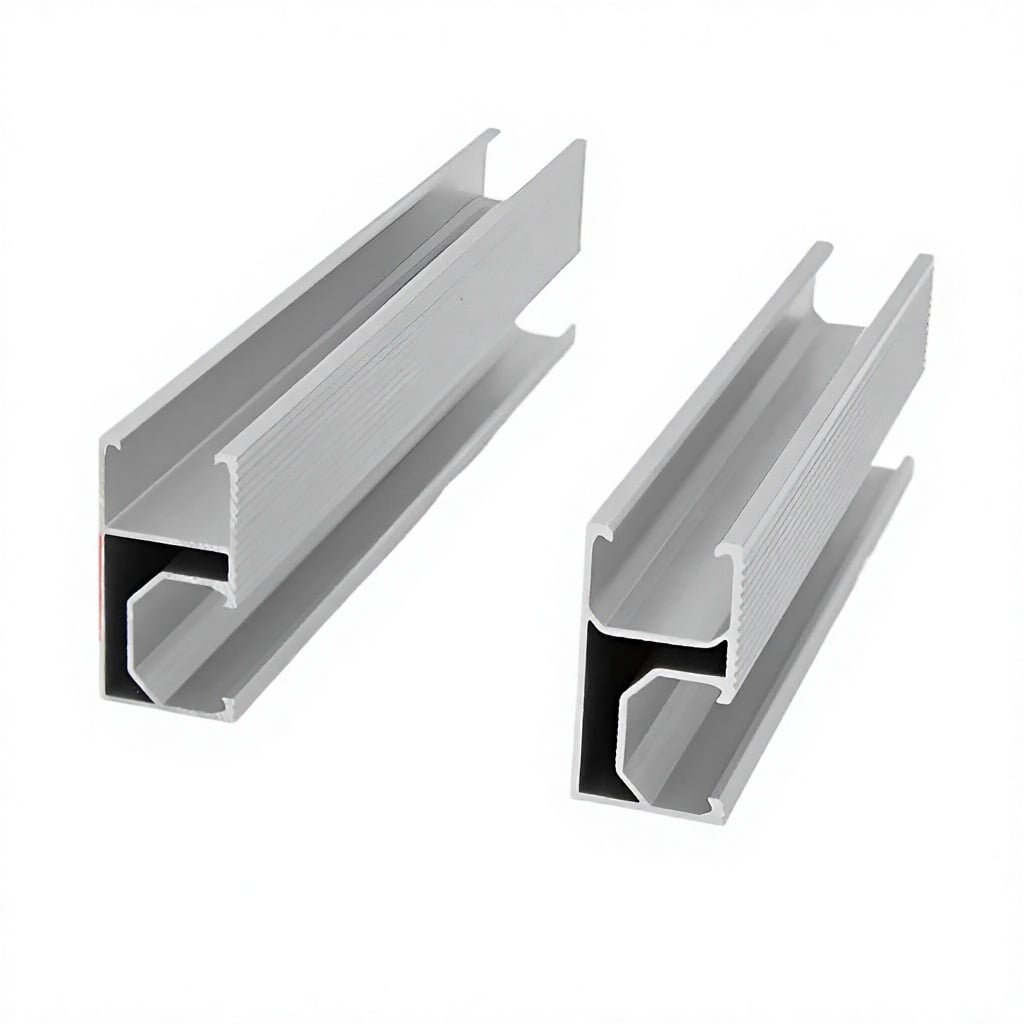
Zn-Al-Mg rails, SS304 rail splice connectors |
6 |
Module mounting |
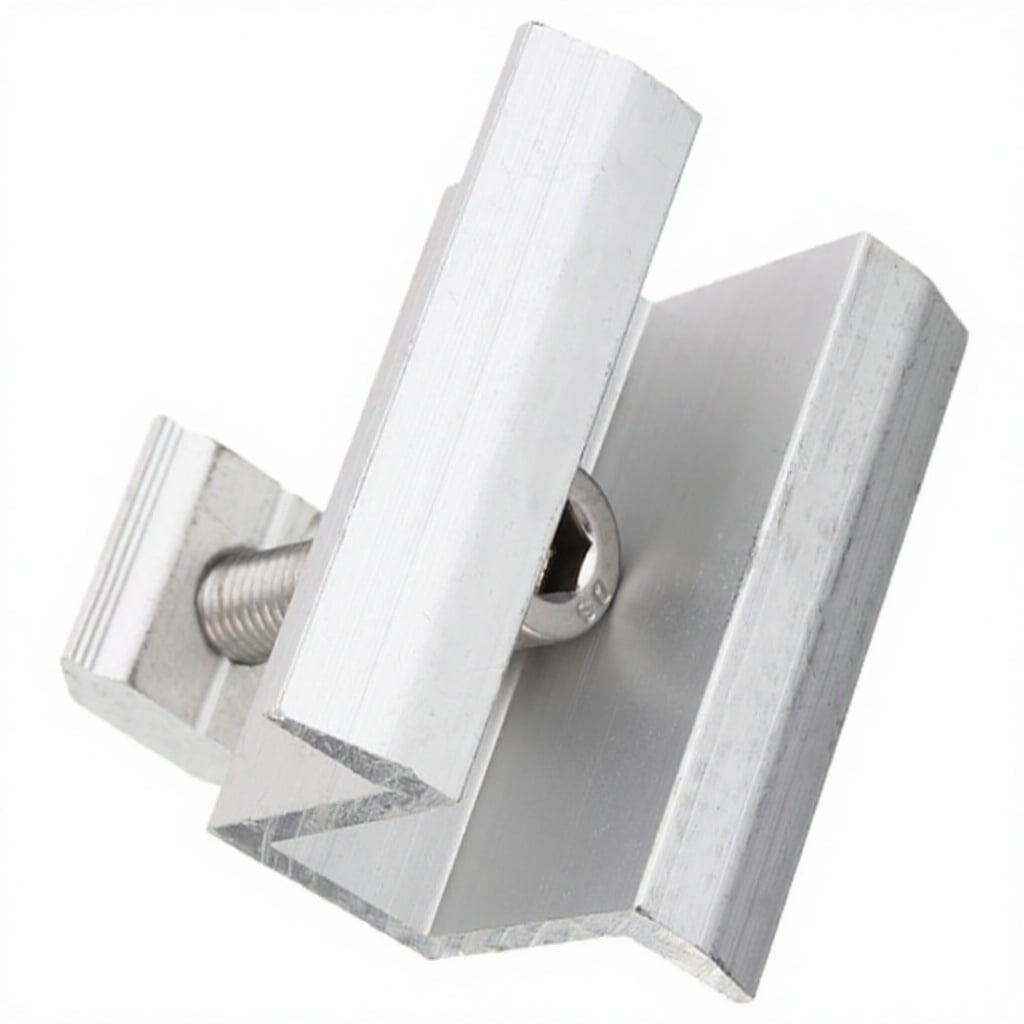
SS304 module clamps; grounding continuity verified |
7 |
Final inspection |
Coating thickness audit; gasket placement verification; fastener material verification |
Challenge: Site located 200m from shoreline on coral atoll. Measured chloride deposition rate 450 mg/m²/day. Monsoon-season wind gusts to 42 m/s. No heavy equipment access — all materials delivered by landing craft. Concrete batching impractical.
Solution: C5 Zn-Al-Mg coated structure with SS316 fasteners. Ground screw foundation with epoxy-coated embedment zone (Ø76mm, 2000mm). 2×10 module layout, 10° tilt. All connection points gasketed. Pre-assembled sub-arrays to minimize on-site handwork.
Result: Installation completed in 68 working days with light equipment only. Annual inspection at Year 3 showed no measurable coating degradation. No fastener corrosion at any of 12,000+ connection points.
Q. Is Zn-Al-Mg really necessary, or is thicker HDG enough?
For C5 environments within 500m of breaking surf, thicker HDG alone is insufficient because the failure mode shifts from uniform dissolution to pitting and crevice corrosion, which HDG does not resist well. Zn-Al-Mg's self-healing chemistry at cut edges and scratches specifically addresses these localized corrosion mechanisms. The cost premium (approximately 12–18% over HDG) should be weighed against the cost of replacing structural components at Year 10–12 — typically 3–5× the initial coating premium.
Q. What fastener material do you use?
SS304 stainless steel as standard; SS316 for projects within 200m of shoreline or in tropical marine environments. We strongly recommend against HDG carbon steel fasteners in C5 environments — thread crest zinc loss during installation creates immediate bare-steel exposure points that corrode within 2–3 years in salt-spray conditions.
# |
Section |
Recommendation |
Format |
1 |
Hero |
Aerial view of coastal solar farm with ocean backdrop |
1920×750px |
2 |
Coating science |
Micrograph comparison: HDG vs Zn-Al-Mg after 2000h salt spray |
800×600px |
3 |
Fastener detail |
Side-by-side: corroded HDG bolt vs pristine SS316 bolt after 3 years coastal |
600×400px |
4 |
Gasket system |
Exploded view showing EPDM isolation at all interfaces |
800×600px |
5 |
Case Maldives |
Island solar installation, modules against turquoise water |
1000×600px |
Primary: C5 solar mounting system, coastal solar ground mount, corrosion resistant solar racking, marine environment solar structure
Secondary: Zn-Al-Mg solar mounting, offshore solar mounting system, salt spray solar racking, island solar project mounting

 EN
EN