 ×
×


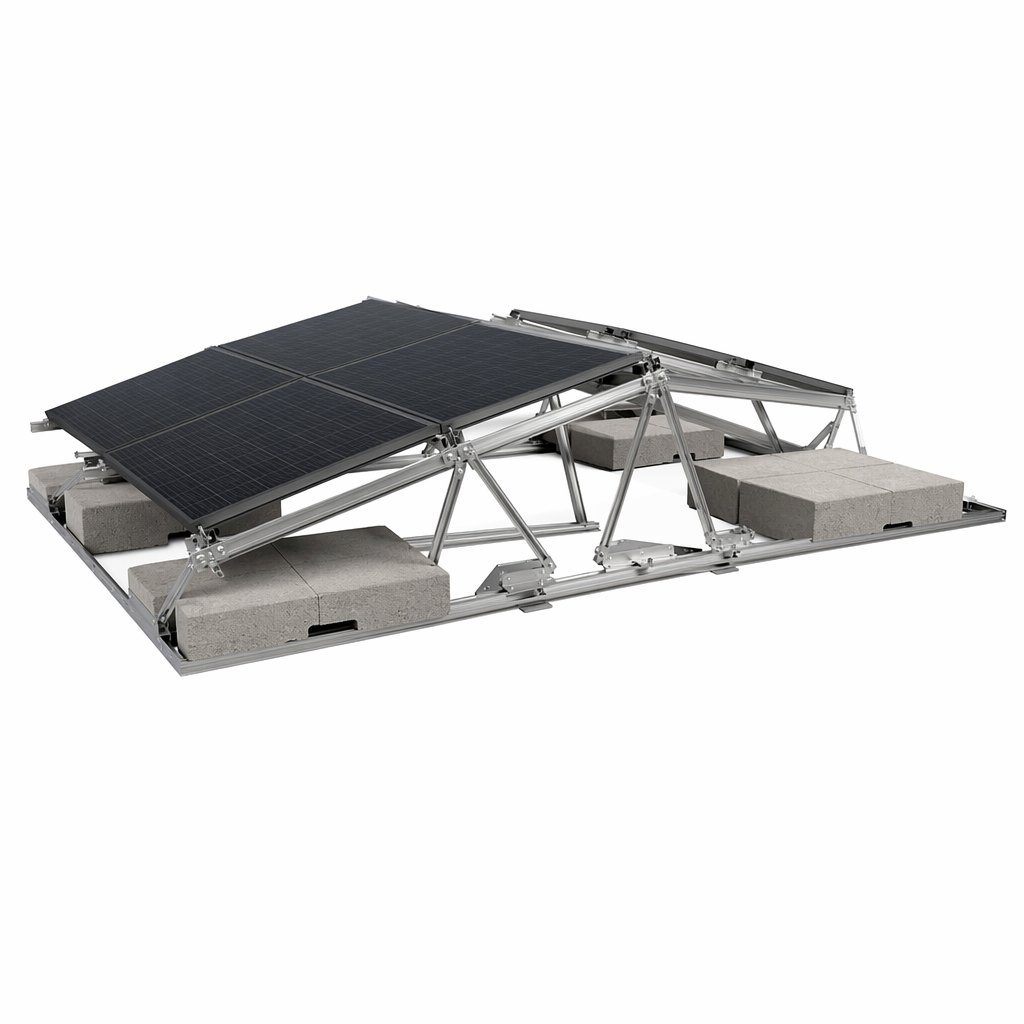
East-West Dual-Tilt Flat Roof Mount System | +30% Rooftop Capacity | High-Density Solar Layout for Maximum Commercial Roof Utilization
On a typical flat commercial roof with south-facing tilted arrays, row-to-row spacing to prevent self-shading leaves 40–50% of the roof unused. This "wasted" space is not optional — it is geometrically required to avoid shading between rows when the sun is low. But what if you could eliminate inter-row shading entirely while still tilting the modules?
The East-West Dual-Tilt Flat Roof Mount System orients modules in opposing east-facing and west-facing rows at a shallow 10° angle, forming a continuous "sawtooth" profile across the roof. Because the rows face away from each other, there is zero inter-row shading — the back of one row is the front of the next. This layout achieves:
+25% to +35% more modules on the same roof area compared to south-facing tilted layouts
Dual-peak daily production: East-facing modules capture morning sun; west-facing modules capture afternoon sun. This flattens the generation curve and better matches commercial building load profiles (morning startup + afternoon cooling)
Lower wind uplift: The continuous sawtooth profile creates a smoother aerodynamic surface than isolated tilted rows, reducing uplift forces and ballast requirements
Self-ballasting interlock: The continuous structure is mechanically interlocked row-to-row, creating lateral stability that resists sliding better than isolated row arrays
Parameter |
Specification |
Roof Type |
Flat / low-slope commercial roof |
Module Orientation |
East-West dual tilt |
Tilt Angle |
10° (east and west) |
Structure Material |
6063-T5 anodized aluminum |
Attachment Method |
Ballasted (no penetration) or mechanically fixed |
Module Density Improvement |
+25% to +35% vs south-facing layout |
Daily Generation Profile |
Dual-peak (morning + afternoon) |
Roof Load |
<15 kg/m² (aluminum + ballast) |
Wind Load Design |
Per ASCE 7 / EN 1991-1-4 |
Warranty |
25 years |
Commercial buildings with morning + afternoon electricity demand
Warehouses and logistics centers with limited roof area
Retail buildings seeking maximum solar coverage for ESG targets
Northern European markets where low sun angles favor shallow tilt
Q. Does east-west orientation reduce total annual generation vs south-facing?
An east-west system at 10° tilt typically produces 5–10% less annual energy per module than an optimally oriented south-facing system at the same location. However, because you fit 25–35% more modules on the same roof, the total roof energy production is higher. Additionally, the dual-peak generation profile provides higher self-consumption for daytime commercial loads, improving the financial return of behind-the-meter solar.
# |
Section |
Recommendation |
Format |
1 |
Hero |
Aerial of commercial roof with east-west sawtooth solar array |
1920×750px |
2 |
Layout comparison |
Plan view: south-facing vs east-west module layout on same roof |
1000×500px |
3 |
Generation profile |
Line chart: east-west dual-peak vs south-facing single-peak daily curve |
800×500px |
Primary: east west flat roof solar mount, dual tilt roof solar racking, high density rooftop solar, sawtooth solar roof layout
Secondary: commercial roof solar capacity increase, east west PV mounting system, flat roof solar space optimization

 EN
EN