EN
EN



The High-Rise Bottleneck That Frame Scaffolding Can't Solve
On a typical high-rise residential project in Southeast Asia a few years back, the site team had three weeks to get the facade scaffolding up before the curtain wall installers showed up. They went with traditional frame scaffolding—the kind with prefabricated H-frames and cross braces—because that's what the estimator had specified. By day ten, they were only 60% done. The geometry kept throwing curveballs: recessed balconies, staggered floor plates, and a curved corner that required custom-fabricated tube-and-clamp infills. The curtain wall crew ended up sitting idle for eight days. That idle time alone ate up any material savings the frame system had promised.
That project is a textbook case of why frame scaffolding—despite being the fastest option on a perfectly rectangular, featureless facade—often becomes the slowest choice once a building rises past ten stories and starts doing anything interesting architecturally. Ringlock scaffolding, by contrast, thrives precisely in those conditions. The speed advantage isn't just about a few percentage points; it's about a fundamentally different approach to how connections are made and how the structure adapts to the building it wraps.
The Rosette: One Connection Point, Eight Directions
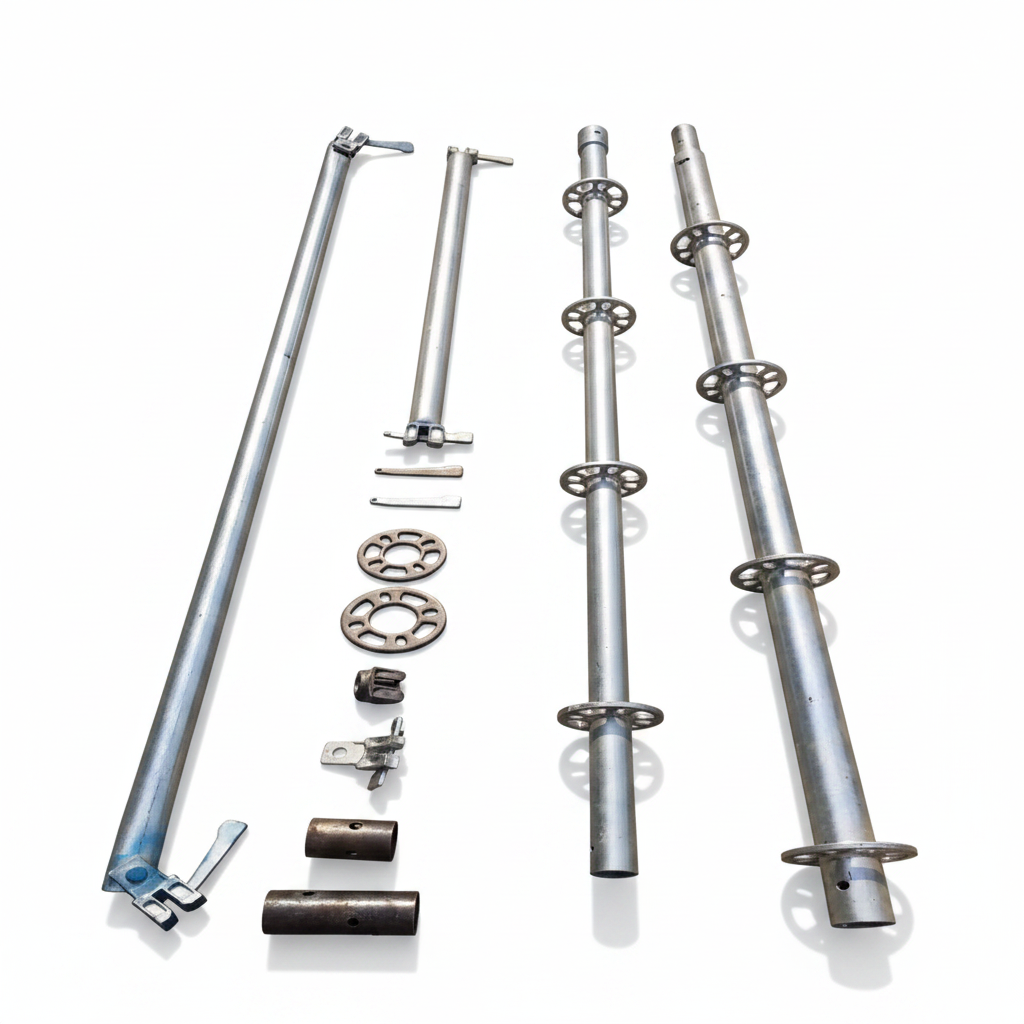
The core differentiator is the rosette—a circular steel disc welded to the vertical standard at regular intervals, typically every 0.5 meters. A ledger or diagonal brace terminates in a wedge-shaped head that drops into any slot on the rosette and gets secured with a single hammer strike. That's it. No loose couplers, no wrenches, no measuring tape to check angles.
Frame scaffolding, by comparison, relies on pre-set geometry. The H-frames establish a fixed bay width and height, and the cross braces snap in at predetermined angles. That works beautifully when every bay is identical. But on a high-rise with varying floor-to-floor heights, setbacks, or non-orthogonal floor plates, those pre-set dimensions become a liability. Every deviation requires either custom components or supplementary tube-and-clamp fittings, which drag erection time back toward traditional levels.
The rosette accepts connections at eight different angles, which means the same standard can support ledgers running perpendicular, diagonals bracing in multiple planes, and even curved facade scaffolding without a single custom-made piece. That flexibility translates directly into fewer minutes per connection and fewer hours spent solving geometry problems on the fly.
Real-World Erection Numbers: Not Just Marketing Talk
The published comparisons are worth looking at closely. One side-by-side analysis found that a tube-and-clamp system takes over 300 minutes to erect a given scaffold volume, while ringlock accomplishes the same job in about 150 minutes—roughly half the labor time. Another source puts ringlock at 30–50% faster than traditional tube-and-clamp systems, and 15–25% faster than cuplock on complex builds.
But those are aggregate numbers. The real gap widens on high-rise projects because of a factor that doesn't show up in simple time studies: logistical complexity at height. Frame scaffolding components are bulky and awkward to maneuver on crowded elevated platforms. Ringlock components are lighter per piece and connect with positive engagement—the wedge either seats fully or it doesn't, so there's no ambiguity about whether a connection is secure. That reduces the cognitive load on the crew, which matters enormously when you're working 40 stories up with wind loads and limited real estate.
| Scaffold System | Erection Time (Benchmark) | Relative Speed on Complex Geometry | Tool Requirement |
|---|---|---|---|
| Tube & Clamp | 300+ min (baseline) | Slowest—custom fittings for every deviation | Wrenches, levels, measuring tape |
| Frame (Prefab) | ~40–50% faster than tube | Fastest on straight facades, slows dramatically with complexity | Minimal—snap-in braces |
| Cuplock | ~30–40% faster than tube | Moderate—fixed node points limit angular flexibility | Hammer only |
| Ringlock | ~50% faster than tube | Fastest on complex geometry—8-direction rosette eliminates custom parts | Hammer only |
A highway bridge project in China documented a reduction in single-span installation from 72 hours to just 9 hours when switching to a ringlock-based system—an 8x improvement. That's not a typical high-rise facade scenario, but it illustrates the magnitude of what's possible when the system matches the complexity of the structure.
Why Wedge-Locking Beats Bolt-Tightening Every Time
The ergonomics matter more than most specifications acknowledge. A frame scaffolding connection requires the worker to align the brace with pre-drilled holes, insert the pin or bolt, and then secure it. On a repetitive facade, that motion becomes muscle memory. But on a high-rise with varying conditions, the worker has to re-evaluate each connection point.
Ringlock's wedge-locking mechanism eliminates that variability. The wedge head drops into the rosette slot, and one or two hammer blows lock it solid. The connection is self-adjusting—the wedge design accounts for minor manufacturing tolerances and thermal expansion, so the joint remains tight across a range of conditions. Independent tests have shown the wedge-locking mechanism withstands 217 kN of vertical load, about 30% higher than conventional systems.
There's also the parts-count argument. A frame scaffold job on a complex high-rise might require thousands of loose couplers, swivel clamps, and base plates just to handle the geometry that the frames can't accommodate. Ringlock eliminates almost all of those auxiliary components because the rosette handles the angular diversity natively. Fewer parts mean faster sorting, faster staging, and less time spent hunting for the right fitting.
The High-Rise Premium: Speed Compounds with Height
On a low-rise building, the difference between a six-hour erection and a nine-hour erection might not move the schedule needle much. On a 50-story tower, those differences compound across dozens of lifts, multiple work fronts, and tight coordination with other trades. Every hour saved on scaffolding erection is an hour that the cladding crew, the MEP installers, or the finishing team can use productively.
One estimating rule of thumb used in the industry puts the labor time for a standard 6-meter-high facade at 100 hours for tube-and-clamp, dropping to 50–70 hours for ringlock. For a high-rise where that facade gets repeated 20 or 30 times, the cumulative savings run into the hundreds of labor hours—and that's before factoring in the reduced crane time, the lower injury risk from fewer manual handling tasks, and the faster progress on subsequent trades.
The speed advantage of ringlock on high-rise jobs isn't a marketing claim; it's a structural reality rooted in connection design, parts reduction, and geometric flexibility. Frame scaffolding still has its place—on straightforward, repetitive low- to mid-rise facades, it remains the fastest option. But once the building starts doing anything interesting, ringlock pulls ahead, and the gap only widens as the structure goes higher.
Manufacturers like STL Sun have built their production around the precision tolerances that make ringlock's wedge-locking system work reliably at scale. Consistent rosette spacing, uniform wedge dimensions, and strict quality control over the galvanizing process—these are the unglamorous details that determine whether a ringlock system delivers its promised speed on a real jobsite, not just in a vendor's promotional video.