 ×
×


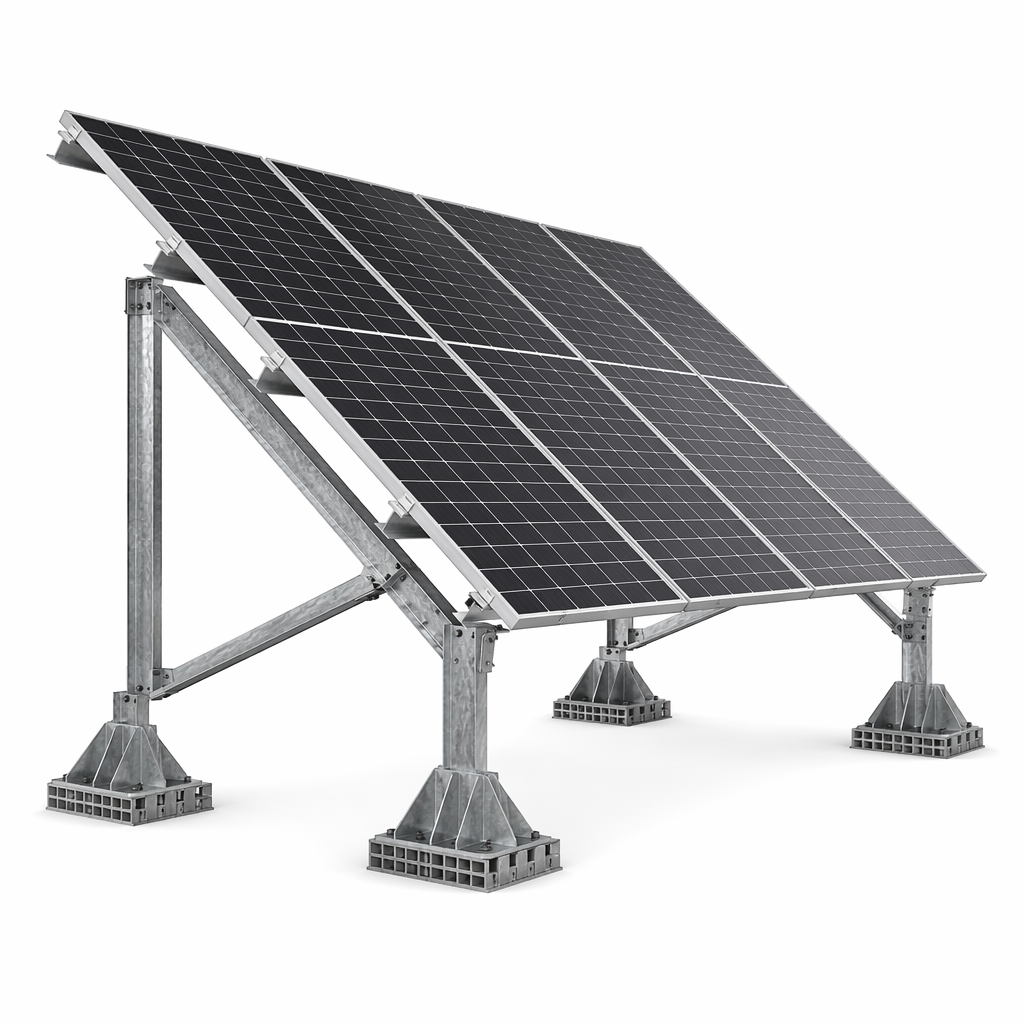
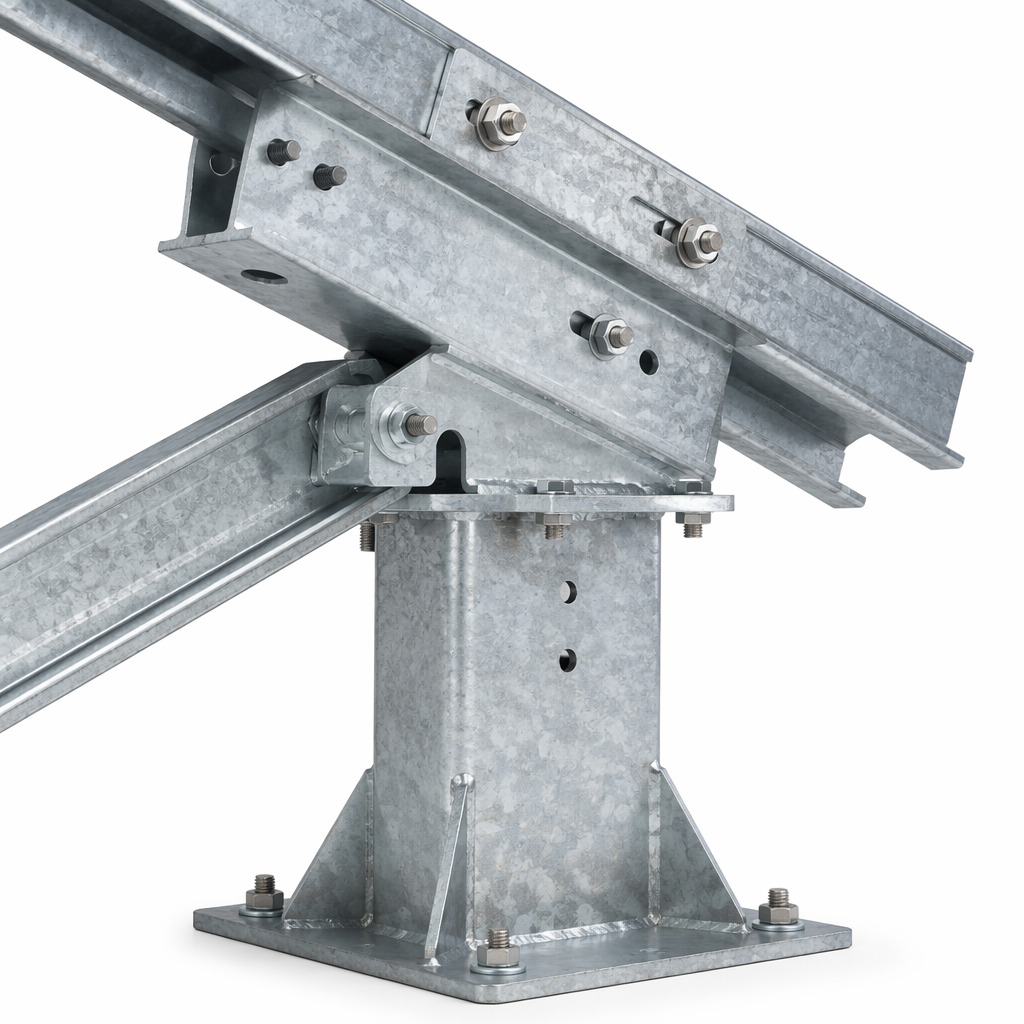
Desert-Grade Fixed-Tilt Ground Mount | HDG Steel Structure for High-Temperature, High-UV, Sand-Abrasion Solar Environments
Desert solar projects present a unique combination of structural challenges that standard mounting systems are not designed to handle: ambient temperatures exceeding 50°C that reduce steel yield strength, fine abrasive sand that accelerates coating erosion, diurnal temperature swings of 30°C+ that stress bolted connections through thermal cycling, and the near-total absence of freshwater for concrete mixing.
The Desert-Grade HDG Fixed-Tilt Ground Mount System is engineered specifically for these conditions. Built on Q355B structural steel with hot-dip galvanized coating ≥85μm (C4), and optionally upgraded to Zn-Al-Mg alloy coating (C5) for sabkha and coastal-desert interfaces, this system has been deployed and validated across the Middle East, North Africa, and Australian outback.
Key differentiators from standard ground-mount systems:
Temperature-de-rated structural calculations: Our engineering team applies temperature correction factors to steel yield strength and modulus of elasticity per EN 1993-1-2, accounting for the 8–12% reduction in structural capacity at 60°C ambient
Open-channel profile design: Unlike box sections that trap sand and create abrasive wear points, our rail and beam profiles use open C-channel geometries that self-clear in wind, reducing maintenance cleaning frequency
Zn-Al-Mg coating option: For desert-coastal transition zones (e.g., UAE sabkha, Red Sea coast), the Zn-Al-Mg alloy provides sacrificial protection that self-heals at cut edges — critical in environments where surface damage from sandstorms creates constant new exposure points
Driven pile foundation optimized for sandy soils: Embedment depth calculated per EN 1997-1 using site-specific angle of internal friction from geotechnical investigation, not generic assumptions
Desert Heat Structural Integrity: Steel loses approximately 10% of yield strength at 60°C versus 20°C. Our Q355B design incorporates this de-rating factor into every calculation, ensuring the as-built structure meets the design safety factor under actual operating conditions — not just at the 20°C design-basis temperature used in generic catalog products.
Sand Abrasion Resistance: The HDG zinc layer (≥85μm at C4) provides a sacrificial barrier that can tolerate decades of wind-driven sand impingement. For extreme conditions, the optional Zn-Al-Mg topcoat adds a harder, more abrasion-resistant surface with a Vickers hardness 20–30% higher than pure zinc.
Self-Cleaning Geometry: All horizontal surfaces are minimized. Rail profiles are oriented to shed sand rather than collect it. Post-to-beam bracket interfaces use gasketed connections to prevent fine dust ingress that would accelerate galvanic corrosion.
No-Water Installation: The driven pile and ground screw foundation options eliminate concrete entirely, removing the single largest logistical constraint in desert construction — freshwater supply for concrete batching.
Parameter |
Specification |
Structure Type |
Fixed-Tilt Ground Mount (Desert Grade) |
Tilt Angle |
10° fixed |
Module Layout |
2×10 / 2×12 / 2×14 |
Primary Material |
Q355B structural steel (temperature de-rated) |
Surface Treatment |
HDG ≥85μm (C4) / Zn-Al-Mg (C5 option) |
Design Wind Load |
Up to 45 m/s |
Design Snow Load |
N/A (desert profile) |
Operating Temperature |
−20°C to +65°C (material certified) |
Foundation |
Driven pile / Ground screw (no-concrete standard) |
System Voltage |
1500V DC |
Design Life |
25 years |
Warranty |
25 years structural |
Middle East solar parks (UAE, Saudi Arabia, Oman, Qatar)
North African utility projects (Egypt, Morocco, Algeria)
Australian outback solar farms
Atacama Desert (Chile) high-irradiance installations
Desert-coastal transition zones with sabkha soil conditions
Step |
Activity |
Desert-Specific Consideration |
1 |
Site survey |
Verify soil bearing capacity via CPT; note sabkha zones |
2 |
Foundation |
Driven pile with ≥2.5m embedment for loose sand; ground screw in compacted zones |
3 |
Post installation |
Temperature-compensated vertical alignment (thermal expansion allowance) |
4 |
Beam assembly |
Torque verification at ambient temperature; re-check after thermal cycle |
5 |
Rail installation |
Open-channel orientation verified (sand-shedding angle) |
6 |
Module mounting |
Clamp torque per module manufacturer spec; grounding continuity in dry sand |
7 |
Final inspection |
Coating thickness audit; all bolted connections re-torqued |
Challenge: Sabkha soil (high chloride, high groundwater salinity), ambient temperatures reaching 55°C, frequent shamal wind events with sand-laden gusts to 38 m/s.
Solution: Zn-Al-Mg alloy coating on all structural steel (C5 equivalent). Driven pile with 2.5m embedment for sabkha salt-flat conditions. 2×12 module layout, 10° tilt. Full EN 1993 structural calculation with temperature de-rating to 60°C.
Result: 12-week steel delivery. Installation peak 6.1 MW/day. Three years of operation with annual structural inspection showing coating thickness loss <1μm/year — projecting 40+ year effective service life. Client O&M structural cost 40% below benchmark for comparable desert installations.
Designed to EN 1993-1-2 (structural fire/thermal design principles applied to ambient temperature de-rating), EN 1997-1 (geotechnical design for sandy soils), ISO 9223 (C4/C5 corrosivity mapping). Factory: ISO 9001, EN 1090-1 EXC2.
Q. How does the structure handle 50°C+ ambient temperatures?
Q355B steel is tested and certified through its full temperature range. All structural calculations apply temperature de-rating factors per EN 1993-1-2 to ensure the design safety factor is maintained at maximum operating temperature. Post and beam connections include thermal expansion allowance in the connection detail.
Q. Does sand accumulation on rails affect performance?
Our open C-channel rail profile is designed to shed sand under its own weight and wind. Unlike box sections that trap sand and create abrasive slurry when combined with morning dew, our profiles self-clear. For extreme dust-load environments, we recommend annual visual inspection and compressed-air cleaning if needed.
Q. Can you install in sabkha (coastal salt flat) conditions?
Yes. The key is correct foundation design (deeper embedment, larger pile section) and corrosion protection (Zn-Al-Mg, C5 grade). We have successfully delivered 100MW+ in sabkha conditions in the UAE. Soil chloride testing is required during the geotechnical survey to select the correct coating specification.
# |
Section |
Recommendation |
Format |
1 |
Hero |
Panoramic drone shot of desert solar farm at golden hour |
1920×750px |
2 |
Desert challenge |
Split image: sandstorm vs clear day, same system operating |
1200×600px |
3 |
Coating detail |
Cross-section micrograph of HDG vs Zn-Al-Mg after 1000h salt spray |
800×600px |
4 |
Foundation |
Driven pile installation in sandy soil, showing embedment depth |
800×600px |
5 |
Case UAE |
Completed Al Dhafra array with desert context |
1000×600px |
6 |
Self-cleaning |
Close-up of open-channel rail profile showing sand-free surface |
600×400px |
7 |
CTA |
Desert solar farm at sunset with contact overlay |
1920×500px |
Primary: desert solar mounting system, solar ground mount hot climate, desert PV racking structure
Secondary: solar mounting system Middle East, HDG solar structure desert, sabkha solar foundation

 EN
EN