EN
EN


The W-Shape That Became a Global Standard
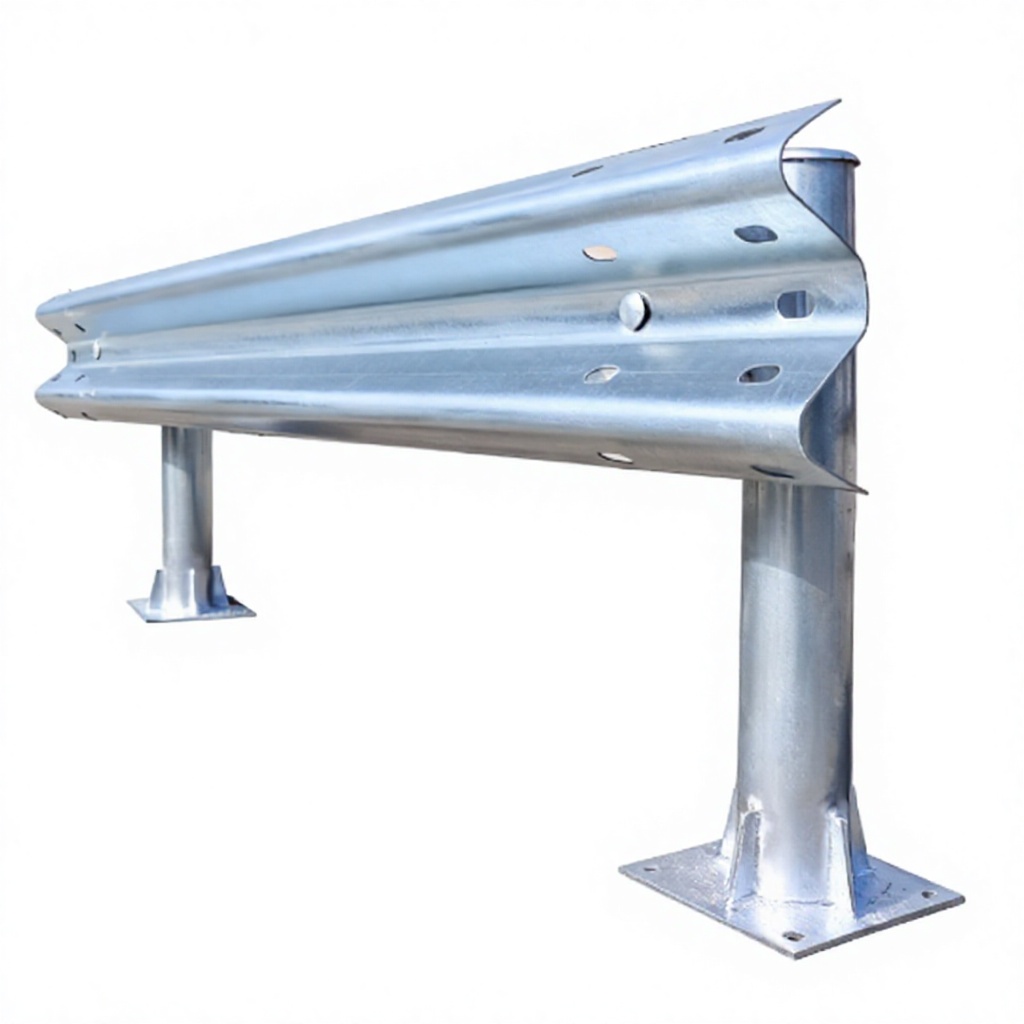
The corrugated steel W-beam guardrail is the most widely used roadside energy-absorbing system in the world. It's installed on highways from rural two-lane roads to urban expressways, from bridge approaches to median barriers. The design has been refined over decades, but the fundamental geometry—a steel sheet formed into a W-shaped cross-section with deep corrugations running longitudinally—has remained remarkably consistent.
The question isn't whether the W-beam works. It clearly does. The question is why that particular profile, with those specific corrugations, outperforms flat beams, shallow-corrugation designs, and other cross-sectional shapes for impact absorption. The answer lies in the mechanics of how the beam deforms under impact and how the corrugations manage the flow of energy through the structure.
Three Deformation Modes, One Beam
When a vehicle strikes a W-beam guardrail, the beam absorbs energy through three distinct deformation modes working simultaneously.
First is cross-sectional distortion. The W-shape isn't just for show—it's a series of folded planes that can flatten, twist, and buckle in ways that a flat sheet cannot. The folds create natural hinge lines that allow the beam to deform progressively, absorbing energy continuously rather than in a single catastrophic fracture.
Second is global flexural deformation. The beam bends along its length, forming a curve that redirects the vehicle. This bending action stores and dissipates energy through the elastic and plastic deformation of the steel.
Third is local deformation at the supports. Where the beam attaches to posts, the corrugations concentrate stresses in predictable patterns, allowing the beam to tear or yield locally rather than failing abruptly at the connection point.
The deep corrugations amplify all three modes. A flat beam would bend but offer little resistance to cross-sectional distortion—it would simply fold over like a piece of paper. The W-shape, by contrast, provides structural depth that resists flattening until the steel reaches yield strength, and then deforms in a controlled, energy-absorbing sequence.
Why Depth Matters: The Section Modulus Argument
The effectiveness of a corrugated beam comes down to section modulus—a measure of a cross-section's resistance to bending. The W-beam's corrugations increase the section modulus without adding significant material weight. A flat steel plate of the same thickness has a much lower section modulus because all the material lies in a single plane. The W-shape moves some of that material away from the neutral axis, where it contributes more to bending resistance.
The deep corrugations—typically 75 to 85 mm in depth for standard W-beam—create a beam that's stiff in the vertical direction but flexible in the horizontal direction. That's exactly the property needed for a guardrail: stiff enough to redirect a vehicle without the beam folding under the wheels, but flexible enough to deform progressively and absorb energy without snapping.
Shallower corrugations, or a flat beam, would either be too stiff (causing high deceleration and potential vehicle vaulting) or too weak (allowing the vehicle to punch through). The W-beam's depth is a carefully optimized balance point.
| Profile Type | Corrugation Depth | Relative Energy Absorption | Failure Mode |
|---|---|---|---|
| Flat beam | 0 mm | Baseline (1x) | Brittle folding, sudden failure |
| Shallow corrugation | 3–5 mm | ~1.5x | Localized buckling, uneven deformation |
| Standard W-beam | 75–85 mm | ~4–5x | Progressive crushing, controlled redirection |
| Deep corrugation (thrie beam) | 100+ mm | ~6–7x | Similar to W-beam, higher capacity |
The Progressive Crushing Sequence
One of the W-beam's most important characteristics is that it crushes progressively rather than failing suddenly. When a vehicle impacts the beam at the post location, the corrugations start to flatten. As the beam deflects, the flattening progresses along the beam, spreading the deformation over a longer length.
This progressive crushing is what keeps deceleration forces within survivable limits. If the beam failed all at once, the vehicle would experience a sudden spike in deceleration. Instead, the force builds gradually as more of the beam engages in the deformation.
The deep corrugations enable this progressive behavior because the folds create multiple potential hinge locations. As the beam deforms, the hinges form and move along the beam, distributing the energy absorption over time and distance. A shallow-corrugation beam has fewer hinge locations and tends to fail more abruptly.
Field observations from crash tests consistently show that W-beam guardrails that meet AASHTO M180 specifications—with the standard 12-gauge thickness and deep corrugations—exhibit this progressive crushing behavior reliably. Beams that deviate from the standard geometry, whether through thinner material or shallower corrugations, tend to show more erratic failure modes.
Material Thickness and the Corrugation Interaction
The corrugations don't work in isolation. The interaction between corrugation depth and material thickness determines the overall energy absorption capacity. Standard W-beam guardrail uses 12-gauge steel (approximately 2.7 mm thick).
Thicker material would increase energy absorption but also increase weight and cost, and might make the beam too stiff—causing higher deceleration forces. Thinner material would reduce weight but might allow the beam to tear rather than deform progressively. The 12-gauge specification represents decades of empirical optimization.
Research on corrugated beam dynamics has shown that the input energy is dissipated through all three deformation modes working together. The corrugations ensure that the deformation spreads across a significant length of beam rather than concentrating at the impact point. This distribution is what prevents the beam from tearing at the attachment points—a common failure mode in shallower or flatter designs.
What the Deep Corrugations Do That Shallow Ones Can't
A shallow-corrugation beam—say, 3 to 5 mm deep—behaves more like a flat plate with some stiffening ribs. The corrugations provide some bending resistance, but they don't create the same progressive crushing behavior. The deformation tends to localize at the impact point, causing the beam to fold or tear rather than spreading the load.
Deep corrugations, by contrast, create a beam that behaves almost like a series of connected folded plates. Each fold acts as a potential hinge, and the beam can draw on multiple hinges as the deformation progresses. This distributed hinge mechanism is what gives the W-beam its characteristic energy absorption capacity.
There's also a practical installation consideration. The deep corrugations provide natural drainage channels that prevent water from pooling on the beam surface. That might sound minor, but standing water accelerates corrosion, and corrosion reduces the effective thickness of the steel—which directly impacts energy absorption capacity. The W-beam's geometry handles drainage as a side benefit of the corrugation depth.
One project in a coastal region of southern China highlighted this issue. The site team installed a shallower-corrugation beam on a bridge approach because it was slightly cheaper per meter. Within 18 months, the combination of salt spray and standing water had corroded the beam to the point where a routine inspection revealed section loss exceeding 20% in multiple locations. The beam was replaced with standard W-beam, and the replacement has now been in service for over five years with minimal corrosion issues. The deeper corrugations shed water more effectively, and the galvanized coating performs better when it's not constantly wet.
The Thrie-Beam Option: More Depth, More Capacity
The W-beam isn't the only corrugated guardrail profile. The thrie-beam—essentially a W-beam with an extra fold, creating three corrugations instead of two—offers even higher energy absorption capacity. Thrie-beam is typically specified for locations with higher impact speed or heavier vehicle traffic.
But the thrie-beam is also heavier, more expensive, and harder to install. For the vast majority of highway applications, the standard W-beam with deep corrugations provides the optimal balance of cost, performance, and installability. The geometry has been refined over more than half a century of real-world use and full-scale crash testing, and it remains the default choice for good reason.
Manufacturers who understand the interaction between corrugation depth, material thickness, and galvanizing quality—like STL Sun—produce W-beam sections that consistently meet the AASHTO M180 standard. Consistency matters because even small deviations in corrugation depth or material thickness can shift the failure mode from progressive crushing to sudden tearing. The standard exists for a reason, and the best manufacturers adhere to it rigorously.
Table of Contents
- The W-Shape That Became a Global Standard
- Three Deformation Modes, One Beam
- Why Depth Matters: The Section Modulus Argument
- The Progressive Crushing Sequence
- Material Thickness and the Corrugation Interaction
- What the Deep Corrugations Do That Shallow Ones Can't
- The Thrie-Beam Option: More Depth, More Capacity